


 中文简体
中文简体 Autor: Admin Datum: 2026-06-15
How Do Brushed DC Motors Work and Where Are They Still the Right Choice?
The Operating Principle Behind Brushed DC Motors
A brushed DC motor converts direct current electrical energy into mechanical rotational energy through the interaction of a magnetic field and current-carrying conductors. The fundamental principle is straightforward: when an electrical conductor carrying current is placed within a magnetic field, it experiences a force perpendicular to both the direction of the current and the direction of the field — a relationship described by the Lorentz force law. In a brushed DC motor, this force is applied to the windings of a rotating armature positioned between the poles of a stationary magnetic field source, producing continuous rotation as long as current flows through the circuit.
What distinguishes the brushed DC motor from its brushless counterpart is the mechanism used to maintain the correct current direction in the armature windings as the rotor turns. As the armature rotates, the current direction in each winding must reverse at precisely the right moment to keep the magnetic force acting in the same rotational direction — otherwise the motor would simply oscillate back and forth rather than spin continuously. In a brushed motor, this current reversal is performed mechanically by a commutator: a segmented copper ring mounted on the rotor shaft, against which carbon or graphite brushes press to maintain sliding electrical contact. As each commutator segment rotates past the brushes, the current path through the armature windings switches automatically, sustaining the torque in a consistent rotational direction without any external electronic switching.
Key Components and What Each One Does
Understanding the function of each component inside a brushed DC motor helps in selecting the right motor for a given application, diagnosing failures in service, and making informed decisions about maintenance schedules.
Stator and Magnetic Field Source
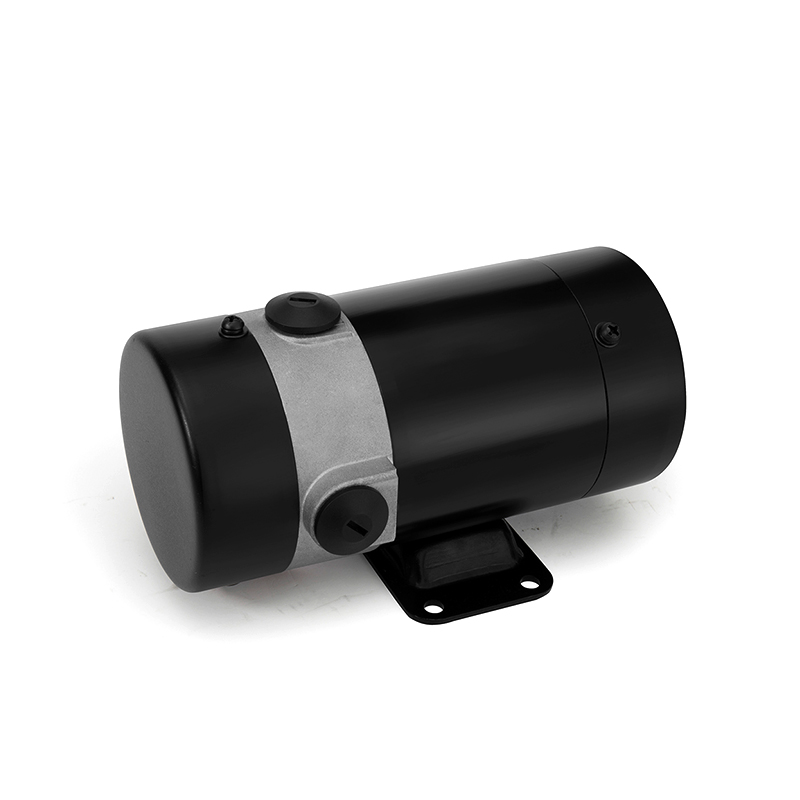
The stator is the stationary outer structure of the motor that provides the fixed magnetic field the armature rotates within. In permanent magnet brushed DC motors — the most common type in small to medium power applications — the stator contains permanent magnets, typically ferrite or neodymium, mounted around the inner circumference of the motor housing. In larger wound-field motors, the stator carries field windings — coils of copper wire — that generate an electromagnet when energized. The strength and configuration of the stator's magnetic field directly determines the motor's torque constant and speed characteristics.
Armature and Rotor Windings
The armature is the rotating assembly at the center of the motor. It consists of a laminated iron core — built from thin stacked steel sheets to reduce eddy current losses — around which copper wire is wound in multiple coils distributed across slots in the core. The number of armature slots and the winding pattern directly affect the smoothness of rotation: more slots produce smaller steps in torque output, reducing the torque ripple that causes vibration and noise at low speeds. The armature windings are connected to the commutator segments in a specific pattern determined by the winding configuration, which also influences the motor's back-EMF characteristics and efficiency curve.
Commutator
The commutator is a cylindrical assembly of copper segments separated by insulating mica or plastic spacers, mounted directly on the rotor shaft and rotating with the armature. Each segment is connected to specific armature winding terminals. As the commutator rotates, the brushes slide from one segment to the next, switching the current path through the armature windings in synchronization with the rotor's angular position. The quality of the commutator — its concentricity, segment spacing, and surface finish — has a major impact on brush life, electrical noise generation, and the overall smoothness of motor operation.
Brushes and Brush Holders
The brushes are the wear components of a brushed DC motor. They are typically made from graphite, carbon-graphite, or metal-graphite composites and are spring-loaded against the commutator surface to maintain consistent electrical contact pressure through the brush's service life as it gradually wears down. The brush material is selected based on the operating voltage, current density, speed, and environment: higher graphite content provides better lubrication and lower friction at high speeds, while metal-graphite grades handle higher current densities at lower speeds. Brush wear produces fine carbon dust that can contaminate the motor interior and must be managed through periodic cleaning in high-duty applications.
Types of Brushed DC Motors and Their Characteristics
Brushed DC motors are produced in several configurations that differ in how the magnetic field is generated and how the field and armature windings are electrically connected. Each type produces a distinct speed-torque relationship that suits different load profiles.
| Motor Type | Field Source | Speed Regulation | Typical Use |
| Permanent Magnet | Fixed magnets | Good, linear torque-speed | Robotics, automotive, tools |
| Series Wound | Field in series with armature | Poor — speed varies with load | Traction, cranes, starters |
| Shunt Wound | Field parallel to armature | Good — relatively constant speed | Lathes, conveyors, fans |
| Compound Wound | Both series and shunt windings | Moderate — balanced characteristics | Elevators, printing presses |
The series wound motor deserves particular attention because its torque-speed curve is fundamentally different from the others. At startup or under heavy load, the series motor produces extremely high torque — because the field current and armature current are the same, both increase together under load, and torque is proportional to the product of field flux and armature current. At light loads, however, the series motor can accelerate to dangerously high speeds because the field weakens as current drops. This is why series wound brushed DC motors should never be operated without a connected load, and why they remain the standard choice for applications requiring very high starting torque, such as electric vehicle traction motors in older designs and engine starter motors.
Speed Control Methods for Brushed DC Motors
One of the most practical advantages of brushed DC motors is how straightforwardly their speed can be controlled. Because motor speed is directly proportional to the voltage applied across the armature (minus the voltage drop due to armature resistance), varying the supply voltage varies the speed in a predictable and linear way. This relationship makes brushed DC motors inherently compatible with simple, low-cost control circuits.
- PWM (Pulse Width Modulation): The most widely used method in modern applications. A switching circuit rapidly turns the supply voltage on and off at a fixed frequency, varying the duty cycle — the proportion of on-time to off-time — to control the average voltage delivered to the motor. PWM control is efficient because the switching transistors dissipate minimal power compared to linear voltage reduction methods, and it allows precise, smooth speed control from near-zero to full speed using inexpensive microcontroller-based driver circuits.
- Armature voltage control: Varying the DC supply voltage to the armature directly controls speed while maintaining full field strength, preserving maximum torque capability at reduced speeds. This approach is used in larger industrial drives where a variable DC power supply is available.
- Field weakening: In wound-field motors, reducing the field current weakens the magnetic field, allowing the armature to spin faster for the same applied voltage. This extends the speed range above the base speed at the cost of reduced torque. Field weakening is used in applications requiring a wide speed range, such as electric traction systems and large industrial drives.
- H-bridge circuits: For applications requiring bidirectional rotation — robotics, positioning systems, actuators — an H-bridge circuit allows the polarity of the voltage applied to the motor to be reversed electronically, reversing the direction of rotation without physically reconnecting wires. H-bridge drivers are available as integrated circuits in packages suited to both small signal motors and high-current industrial motors.
Where Brushed DC Motors Are Still the Preferred Choice
Despite the increasing adoption of brushless DC motors in many applications, brushed motors retain clear advantages in specific use cases that continue to justify their selection in new designs and replacement scenarios.
In automotive systems, brushed DC motors remain standard for a large number of low-power auxiliary functions: window regulators, seat adjustment actuators, mirror positioning, windshield wiper systems, HVAC blend door actuators, and fuel pump assemblies in older vehicle designs. The total number of brushed DC motors in a conventional passenger vehicle typically ranges from 20 to over 40 units, depending on the specification level. Their continued use in these roles reflects the cost advantage — a small brushed motor with a simple PWM speed control circuit is significantly cheaper to manufacture than an equivalent brushless system with its required position sensors and more complex electronic commutation circuitry.
- Power tools: Corded drills, circular saws, angle grinders, and reciprocating saws continue to use brushed motors in value-oriented product lines. The high starting torque and simple speed control make them effective for intermittent-duty tool applications where brush life is not a limiting factor given the product's overall service life.
- Hobbyist robotics and education: Brushed DC motors remain the dominant choice for entry-level robotics, hobby RC vehicles, and educational kits because of their extremely low cost, simple two-wire connection, and compatibility with basic motor driver modules available at minimal expense.
- Appliances: Portable mixers, blenders, vacuum cleaners, and other household appliances with moderate duty cycles and defined service lives use brushed motors where brush replacement is not expected to be required within the product's intended lifespan.
- Industrial actuators and conveyors: Applications with moderate speed ranges, well-understood load profiles, and accessible maintenance schedules continue to use brushed wound-field motors — particularly shunt and compound types — because their speed regulation characteristics match the load requirements and replacement brush kits are inexpensive and widely available.
Maintenance Requirements and Service Life Considerations
The brush and commutator system is the primary maintenance point of any brushed DC motor and the factor that most directly limits its service life relative to brushless alternatives. Brush wear rate depends on current density, operating speed, commutator surface quality, ambient temperature, humidity, and the presence of contaminants. In well-designed applications operating within rated conditions, brush life typically ranges from 1,000 to over 5,000 operating hours depending on motor size and duty cycle. Monitoring brush length against the minimum specified by the motor manufacturer and replacing brushes before they wear to the point where the spring no longer maintains adequate contact pressure prevents commutator damage that would require more expensive repair.
Commutator condition should be inspected at each brush replacement. A smooth, dark brown patina on the commutator surface — called the film or glaze — is normal and desirable, as it reduces brush friction and wear. Scoring, grooving, or uneven segment wear indicates a problem with brush pressure, brush alignment, or electrical imbalance between armature windings that should be investigated before fitting new brushes. In motors used in dusty or contaminated environments, periodic cleaning of accumulated carbon dust from the brush holders and interior of the motor housing prevents the conductive dust from creating unwanted current paths between commutator segments, which would reduce efficiency and increase the risk of short-circuit faults within the armature winding circuit.

-
Zpětná vazba
Související produkty


Copyright© Hengye Intelligent Drive (Hangzhou) Co., Ltd. Všechna práva vyhrazena

Horká linka:0086-15869193920
Čas:0:00 - 24:00
